Elevating the prospect pipeline: tips and tricks from across CommonSpirit
Prospect research is what keeps our donor pipelines flowing and helps us build the strongest possible relationships with prospective donors. Whether you’re identifying new prospects or preparing outreach, knowledge is power.
Below, find wisdom from three of our colleagues about best practices, how to engage support from the centralized prospect research team, as well as when and how to begin planning a prospect development strategy.
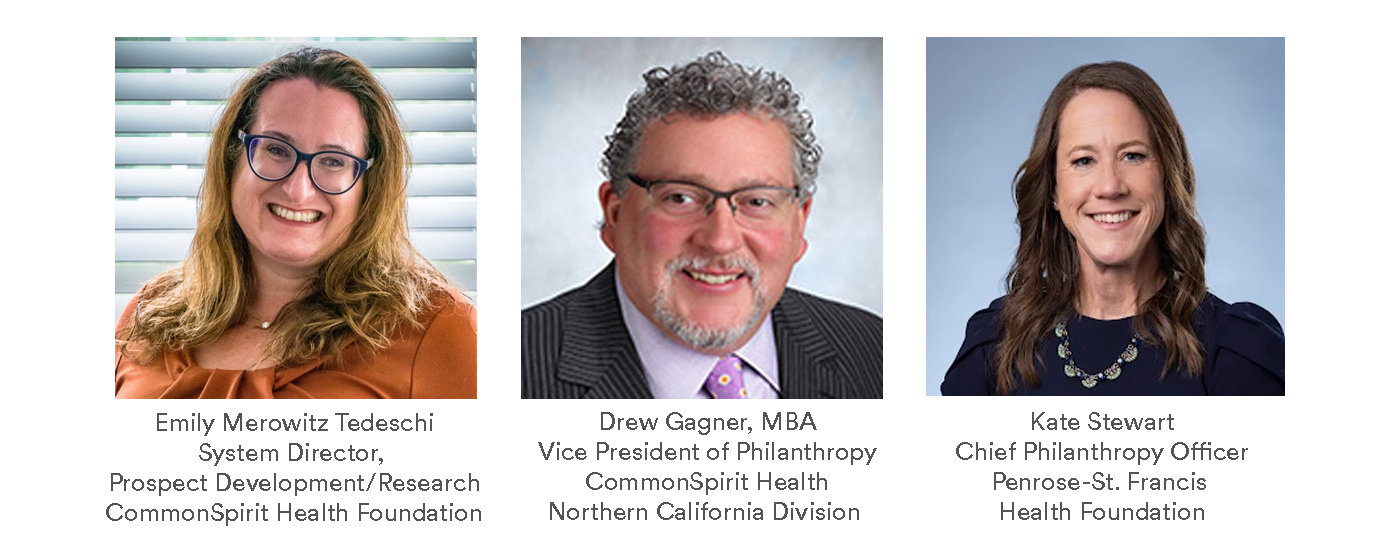
What is your current process for prospect planning as you approach a new fiscal year? When do you start?
Drew: We are constantly and consistently adding prospects, plans and opportunities on a rolling basis — but for forecasting purposes, budget planning and campaign management, putting your action plan together at least six months in advance of the fiscal year is a best practice. If we’re doing it right, we move from reactive opportunity spotting to proactive, portfolio-wide strategic development. Ideally, we are building individual donor journeys for top prospects, not just identifying names. This ensures that when we share opportunities with the donor, they align with both donor capacity and our site’s highest strategic priorities.
Kate: We are always trying to plan not just for the current fiscal year, but for the next fiscal year as well. We know sometimes major gifts will take a while to close, so we prioritize the current fiscal year while always keeping the next in mind. This keeps our pipeline healthy. We largely look at our top recent donors (3 years or so) and top lifetime donors and the dates of their most recent gifts so that we’re prepared to keep them moving through each cycle. Equally important is rotating out the donors and prospects who may be unresponsive.
We work on acquiring new major gift prospects through engagement in our community; small, salon-type events; referrals from our board and other key stakeholders; and through thorough review of recently discharged patients.
Emily: By the end of the third quarter, create a major gift table for the new fiscal year to determine if you have enough prospects to achieve your revenue goal. The prospect development and research team can provide a report of your existing prospects and their estimated capacity, which will help you determine whether you have enough prospects to reach your goal. If you have gaps, we can identify new prospects for you.
When looking at prospect planning, do you currently engage the prospect research team?
Drew: Emily and her team are mission-critical and ought to be integrated from Day 1. They are the eyes and ears, providing the intelligence that fuels our strategy.
We involve the Prospect Research and Development team in initial portfolio reviews to identify what we might call “white space”: hidden gems like new giving areas or expanded giving potential that we didn’t initially realize. Then we connect again for deep-dive profiles as we build tailored cultivation plans.
Emily: We are deeply grateful to have a team of fantastic prospect researchers as well as a “portfolio quarterback” to support our work. It helps us understand more clearly what a prospect’s true capacity might be, other causes they support and how else they are involved in our community. As a result, we build more authentic relationships, project better what the right ask could be and also which program or fund might best match their passion(s).
For prospect planning, do you also plan out projected ask amount and designation focus?
Drew: This is subject to assessment site-by-site and spot-by-spot, especially if we haven’t identified the donor’s intent this early in the process. The best practice is that as soon as we are able, establish “stretch but realistic” opportunity range, and primary designation focus for each high-priority prospect. This isn’t rigid — it’s a guide. It ensures that our outreach is targeted and tied directly to specific initiatives. This discipline avoids generic asks and maximizes gift potential against our strategic goals.
Kate: We do. Sometimes, we have a good idea right off the bat of what the prospect may be willing to support and a giving history to work from. Other times, it takes several rounds of conversation with the prospect to understand what our projected ask will look like. We always try to document that information once we have an understanding to help with fiscal year projections. We are sure to include likelihood of the gift as well, so our projections are more accurate and we can identify gaps to goal.
Do you use any tools to assist you in prospect planning?
Drew: Our core tool is DREAM for donor data and relationship tracking. I subscribe to the mantra that if it’s not in DREAM, it didn’t happen. In addition to our prospect research team, there are a variety of wealth screening tools for initial capacity assessments.
I have long promoted “Bridge Planning,” which you can build using DREAM. This forecast allows for dynamic tracking of cultivation, anticipated ask and strategic alignment, offering a holistic view beyond DREAM. We also recently completed a layered capacity assessment across all our regions, which screens ZIP codes for affinity and hospital market share. On the horizon, we anticipate utilizing AI-driven predictive analytics.
Kate: We have a comprehensive moves management tool in our CRM from which we can run reports anytime. We also use a monthly dashboard tool for each foundation in our region to report out progress as well as discuss how we will address any gaps to goal.
How can the Prospect Development and Research Team help major gift officers?
Emily: The PDR team can assist with grateful patient prospect work by screening patients who see specific physicians. If fundraisers have existing relationships with physicians at their hospitals, we can leverage those relationships to identify grateful patients who have both the affinity and capacity to make major gifts to your foundation.
###
More stories